Security Cameras, Access Control & Multi-Site Surveillance
IP camera systems, cloud and on-prem video, access control, and multi-building campus surveillance for NY, NJ, and the Northeast. From a single-office Verkada install to a 28-building public housing camera and network design.
Written quote in 48 hours on every project — and managed clients get our published SLA: 14-min average response, 30-day out clause.
What's included
- IP camera system design — single-site through 28-building multi-property campus
- Cloud-managed VMS (Verkada, Eagle Eye, Rhombus) and on-prem NVR (Speco, Hanwha, Hikvision, Axis)
- Ubiquiti UniFi Protect deployments for SMB single-site and small-campus
- Access control — keycards, fobs, mobile wallet credentials, biometrics
- Brivo, Verkada Access, Openpath / Avigilon Alta, Kisi, Genea integrations
- Intrusion alarm with central-station monitoring (via licensed partner alarm dealers)
- Door and panic hardware coordination with locksmith and door-hardware contractors
- Visitor management (Envoy, Greetly, SwipedOn) integrated with access control
- License plate recognition (LPR) for parking and gated communities
- PoE+ / PoE++ switch design and dedicated surveillance VLAN architecture
- Compliance-aware retention — HIPAA, PCI-DSS, school district, and public-sector
- Cabling and conduit installed by the same team — see structured cabling
- 24/7 monitoring of camera health, NVR storage, and network connectivity for managed clients
Security infrastructure, designed and supported by your IT team
Cameras and access control are part of your IT system whether your IT team manages them or not. They run on your network, store data on your storage, integrate with your identity, and break in ways that look a lot like network problems. We deploy and support them so the same team that runs your IT runs your physical security — with documentation, monitoring, and a support phone number that picks up.
Single-site, multi-site, and multi-building campus
Single-site deployments — 2 to 32 cameras at one location. Office, restaurant, retail, clinic, warehouse. UniFi Protect or Verkada for cloud-managed; Speco or Hanwha for on-prem NVR. Typical install is 1–3 days of cabling and 1–2 days of configuration and tuning.
Multi-site deployments — restaurant groups, retail chains, healthcare practice groups with 5 to 50 locations. Verkada and Eagle Eye are the cleanest fit at this scale because the centralized management cost is justified by the operational savings — your manager in one location can pull footage from any other without bouncing through 50 separate NVR logins.
Multi-building campus deployments — public housing properties, college and university campuses, K-12 districts, hospital and healthcare campuses, multi-tenant office portfolios, distribution centers, and large industrial sites. This is its own discipline. We are currently engaged on a 28-building residential campus where Sage is the camera and network design partner across the entire complex.
What changes at campus scale: inter-building fiber backbone (single-mode OS2 over conduit between buildings); PoE+ or PoE++ switching at every building rather than centralized PoE; distributed NVR architecture so a single point of failure does not take down 200 cameras; centralized monitoring console viewable by site operators, the property manager, and where appropriate the local PD; an IP plan that gracefully grows with new buildings; physical security for the network plant in every building; and a 24/7 monitoring strategy that handles single-building outages without blowing up the entire campus dashboard. See the network design page for the network backbone side of campus work.
What we deploy
IP camera systems — modern megapixel IP cameras with proper coverage planning, true low-light performance, motion analytics, and ONVIF compliance for vendor flexibility. Lens selection matched to the actual scene rather than spec-sheet defaults. Outdoor housings, vandal-proof domes, and multi-sensor fisheye where the application warrants.
- Ubiquiti UniFi Protect — best value for SMB single-site and small-campus deployments where the network is already UniFi. No recurring license, full-featured, includes the Ubiquiti AI suite. Common pick for offices, restaurants, retail, clinics, and warehouses up to about 32 cameras per site.
- Speco Technologies — long-tenure brand for both analog-and-IP hybrid retrofits and pure IP. Strong in retail, healthcare, hospitality, and public-sector environments where local storage and audit-friendly retention matter. Their NVR platform is straightforward and well-supported.
- Verkada — cloud-managed, single-pane-of-glass for multi-location clients and centrally administered campuses. Higher recurring cost, but the management model is excellent when you have 5 or more sites or want non-IT staff to operate the system.
- Eagle Eye Networks — alternative cloud-managed VMS, often the right call for very large multi-site deployments where Verkada’s cost curve gets steep.
- Hanwha (Wisenet), Hikvision, Axis — for higher-end on-prem NVR deployments and specialized use cases — high-resolution recording, low-light, outdoor, fisheye, multi-sensor, LPR, or compliance-driven retention.
Access control — keycards, fobs, mobile wallet credentials (Apple Wallet, Google Wallet), and biometric where the policy warrants. Door hardware coordination with locksmith and door-hardware vendors. Brivo, Verkada Access, Openpath / Avigilon Alta, Kisi, Genea, and traditional standalone systems where appropriate. Identity integration with Microsoft 365 / Google Workspace and HR onboarding so when someone is hired or fired, their access updates automatically.
Intrusion alarm — door, motion, and glass-break sensors, panic buttons, central station monitoring. We partner with licensed alarm dealers; we handle the IT and integration with cameras and access for unified incident response.
Visitor management — Envoy, Greetly, SwipedOn for client-facing offices and clinics, integrated with access control for badge printing and check-in.
License plate recognition — Verkada, Hanwha, Vigilant, and Genetec LPR for gated communities, public housing entrances, parking, fleet yards, and school perimeters.
Common projects
Office buildouts where cameras, access, alarm, network, and AV are all installed at once. Camera system replacements when an old DVR-era system is at end-of-life. Multi-location standardization for restaurant groups, retailers, and clinics that grew from one to many sites with mismatched systems. Compliance-driven deployments for healthcare, retail, and warehousing where retention and chain-of-custody matter. Multi-building public housing, university, and school district deployments where central monitoring and a scalable IP plan matter as much as the camera spec sheet. Cabling-only sub-contracts where the camera vendor pulls the cable and we handle the network and switch design. See structured cabling for the cable side.
What it costs
Camera systems and access control are project-priced — the variables that move the number are camera count and resolution, mounting complexity (interior vs. exterior, low ceiling vs. high pole, conduit vs. J-hook pathway), the storage architecture (cloud vs. on-prem vs. hybrid, retention duration), door-hardware modifications, panic-bar integration, and the cabling pathway through the building. Multi-location and large-campus deployments scale with volume hardware discounts and standardized labor templates. We provide written quotes itemized line-by-line so the trade-offs between hardware tiers and storage durations are visible before you commit. Request a quote and we will walk the site or campus.
Pair with the rest of the stack
Cameras live on a network. They draw PoE from switches. They store data on NVRs or in the cloud. They integrate with access control and the building’s identity. We deliver all of that as one accountable team — see network design for the backbone, structured cabling for the wire, design-build for fully integrated buildouts, and managed IT for the ongoing 24/7 monitoring and support.
From our installs
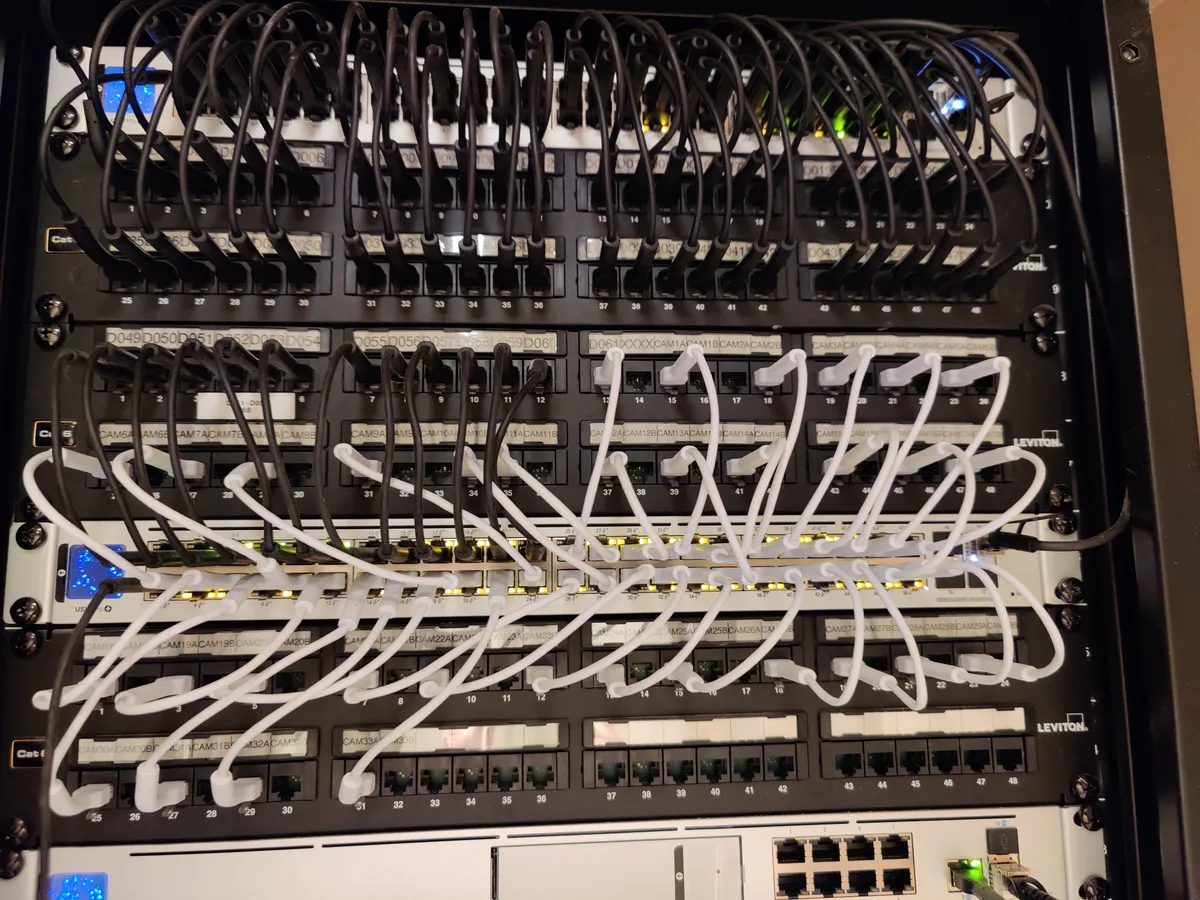
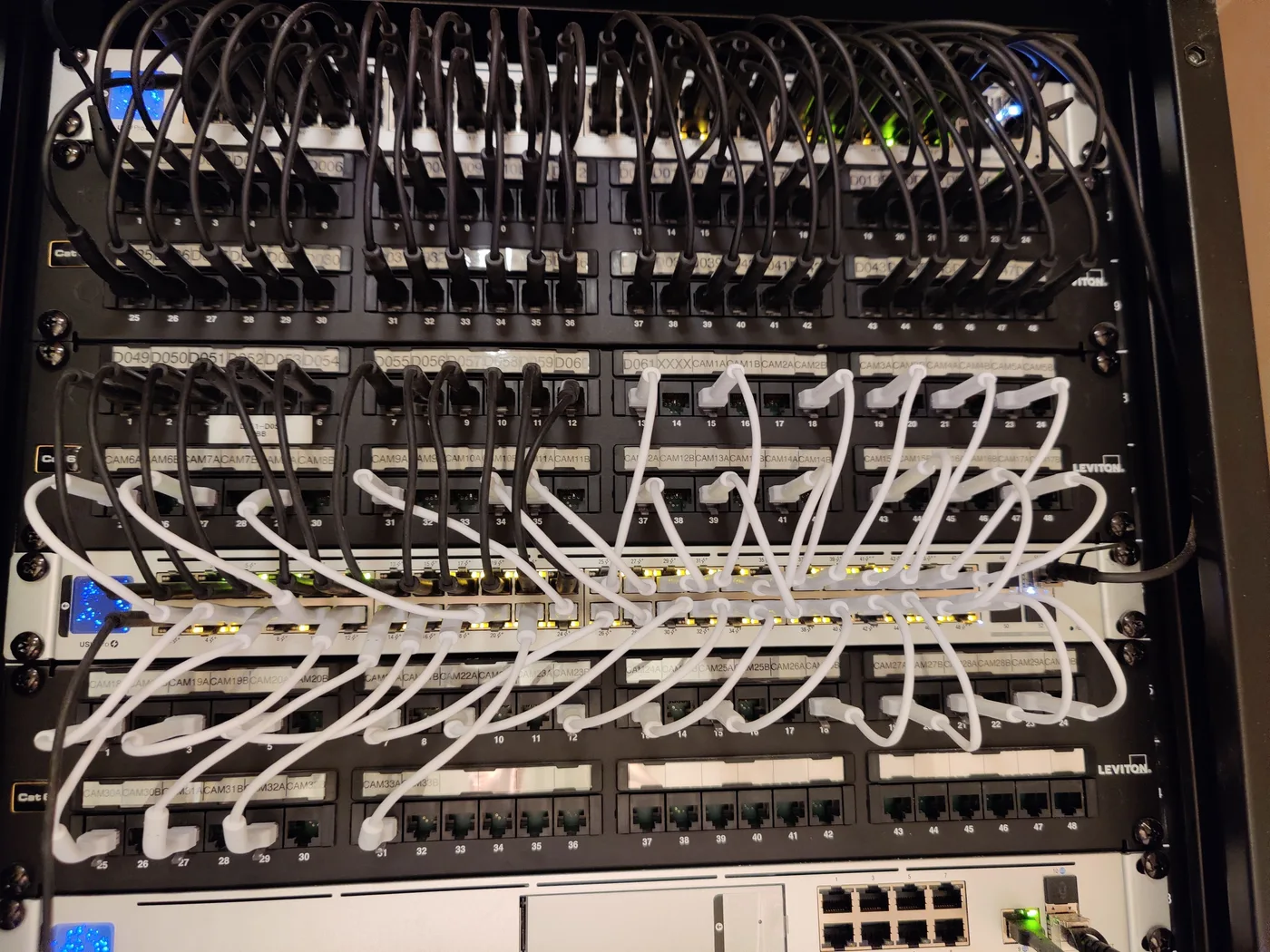
Security Cameras, Access Control & Multi-Site Surveillance — questions we get
What camera systems do you deploy and how do you choose?
We work with Ubiquiti UniFi Protect, Speco Technologies, Verkada, Hikvision, Hanwha, Axis, and Eagle Eye. UniFi Protect is excellent value for SMB single-site and small-campus deployments where the network is also UniFi-managed; Speco is our go-to for hybrid analog-and-IP retrofits and clients who want long-tenure local NVR storage; Verkada is the right cloud-managed answer for multi-location and centrally administered deployments; Hanwha, Hikvision, and Axis are deployed where higher resolution, low-light performance, or specialty form factors are required. Deployments are standardized so your IT team has one consistent stack to support.
Do you do multi-building and campus camera systems — public housing, schools, hospitals, multi-tenant office?
Yes. Multi-building and campus surveillance is its own discipline. We are currently engaged on a 28-building residential campus where Sage is the camera and network design partner across the entire complex. The work spans inter-building fiber backbone, building-level PoE switching, distributed NVR architecture, central monitoring, and an IP plan that scales to hundreds of cameras and dozens of subnets without becoming brittle. See the [network design service page](/services/network-design/) for the network backbone side.
How many cameras can a single deployment scale to?
Our smallest deployments are 2 to 4 cameras for a single retail storefront. Mid-size offices and restaurants typically run 16 to 32 cameras. Multi-location chains and large warehouses run 64 to 128 per site. Multi-building campus deployments scale into the hundreds with distributed NVR or hybrid cloud architecture. The architectural choices change at each tier — what works at 16 cameras does not work at 160.
Cloud-managed VMS or on-prem NVR — which should I choose?
Cloud-managed (Verkada, Eagle Eye, Rhombus, UniFi Protect Cloud Key) is the right answer when you have multiple locations, want non-IT staff to view footage, prioritize remote management, and can absorb the recurring license cost. On-prem NVR (Speco, Hanwha, Hikvision, Axis Camera Station) is right when you need long retention (90 days or more), have compliance requirements that prefer physical storage, want to avoid recurring license fees, or operate on a network that is not always internet-connected. We commonly deploy hybrid — local NVR for primary recording, cloud for off-site backup and remote viewing.
Do you integrate access control with our existing systems?
Yes. Modern access control (Brivo, Verkada Access, Openpath / Avigilon Alta, Kisi, Genea) integrates with Microsoft 365 / Google Workspace identity, with HR systems for automatic onboarding and offboarding, and with intrusion alarm and video for unified incident response. We also install on traditional standalone access control where the use case is right.
Are you a licensed alarm installer in NY/NJ?
For monitored intrusion alarm we partner with licensed local alarm dealers and central stations. We handle the IT and integration; the alarm dealer holds the license and contracts the central-station monitoring. Cleaner separation of liability and cleaner for the inspection paperwork.
What about license plate recognition (LPR)?
Yes — LPR is increasingly common at gated communities, public housing, parking facilities, fleet yards, and school perimeter. We deploy on Verkada, Hanwha Wisenet, and dedicated LPR systems (Vigilant, Genetec) where the use case warrants. Storage and retention need separate planning because LPR generates more data per camera than standard surveillance.
How do you handle compliance retention — HIPAA, PCI, school district?
Retention requirements drive storage architecture. HIPAA does not prescribe a specific video retention but auditors expect documented policy and chain-of-custody. PCI-DSS expects a minimum of 90 days. School and public-sector retention varies by jurisdiction — typical is 30 to 90 days. We design storage capacity for the documented retention requirement plus margin, document the policy, and implement the chain-of-custody export workflow before the system goes live.
Can the cameras be on the same network as the rest of the business?
They can be, but they should not be flat. We deploy IP camera systems on a dedicated surveillance VLAN with no inbound internet access (cameras phone-home only when explicitly required and only over policy-controlled paths). This protects the rest of the network from camera firmware vulnerabilities and protects the cameras from network-borne attacks. Multicast and bandwidth controls are tuned so streaming traffic does not degrade business applications.
Security Cameras, Access Control & Multi-Site Surveillance — recent case studies
- Multi-Building Residential — Public Housing
Oak Park, Stamford CT: 305-Camera Multi-Building Surveillance Backbone
Network design, switch programming, and IP video surveillance integration across a 28-building multi-dwelling community in Stamford, CT — Phase 1 existing (75 cameras) integrated with Phase 2-3 expansion (~230 new cameras across 20 new townhome buildings on a redesigned 10G fiber backbone).
Read more about Oak Park, Stamford CT: 305-Camera Multi-Building Surveillance Backbone - Transportation & Logistics
Logistics Company Builds Out 28,000 sq ft Warehouse with Cameras, Access, and Wi-Fi
A growing 3PL company opened a new warehouse in northern New Jersey and engaged Sage to handle every piece of low-voltage and IT infrastructure: structured cabling, Wi-Fi, security cameras, access control, and the back-office network.
Read more about Logistics Company Builds Out 28,000 sq ft Warehouse with Cameras, Access, and Wi-Fi
Other services we deliver
Structured Cabling & Low-Voltage Wiring
Cat 6/6A, fiber, coax, speaker, fire alarm, burglar, paging — every low-voltage run, certified and documented.
Read more about Structured Cabling & Low-Voltage WiringNetwork Design & Multi-Site Engineering
Site surveys, network architecture, multi-building campus design — built right the first time.
Read more about Network Design & Multi-Site EngineeringDAS / In-Building Wireless
Passive DAS, hybrid DAS, and ERRCS/BDA public safety systems — cell signal and first responder coverage for commercial buildings.
Read more about DAS / In-Building Wireless
Security Cameras, Access Control & Multi-Site Surveillance for your industry
Security Cameras, Access Control & Multi-Site Surveillance across the NY & NJ metro
Local pages with neighborhood-specific detail for security cameras, access control & multi-site surveillance.
Ready for IT that does not surprise you?
A 30-minute call. No slide deck. We will tell you what looks healthy, what looks risky, and what we would do first.