Oak Park, Stamford CT: 305-Camera Multi-Building Surveillance Backbone
Network design, switch programming, and IP video surveillance integration across a 28-building multi-dwelling community in Stamford, CT: Phase 1 existing (75 cameras) integrated with Phase 2-3 expansion (~230 new cameras across 20 new townhome buildings on a redesigned 10G fiber backbone).
28
Buildings under unified design
~305
Cameras at full deployment
10G
Inter-building backbone uplinks
0
Multimode plant replaced (Phase 1 preserved)
Timeline
Phase 1 complete · Phase 2 deployment 2026 · Phase 3 follows on Lot RM-7
Services used
The challenge
Oak Park is a multi-dwelling community on Ursula Place and Orange Street in Stamford, Connecticut. Phase 1 deployed roughly 75 IP cameras across the existing buildings on a multimode-fiber backbone. Phases 2 and 3 add twenty new townhome buildings across lots RM-5 through RM-8 and require roughly 230 additional cameras, bringing the campus to approximately 305 cameras under unified management. The architectural challenge is integration: the new build needs to share a single monitoring console, identity surface, and IP plan with the existing Phase 1 plant without forklift-replacing the multimode fiber that's already in the ground. Additionally, the combined ~305-camera stream load exceeds a single NVR's 150-stream capacity, so the network must split video traffic across two NVRs while still presenting operators with a single view.
The work
Sage Solutions is the network design and switch-programming partner on Oak Park, engaged by the project’s prime contractor. The Phase 2-3 scope adds approximately 230 IP cameras across 20 new townhome buildings and integrates them with the existing 75-camera Phase 1 system on a unified 10G fiber backbone.
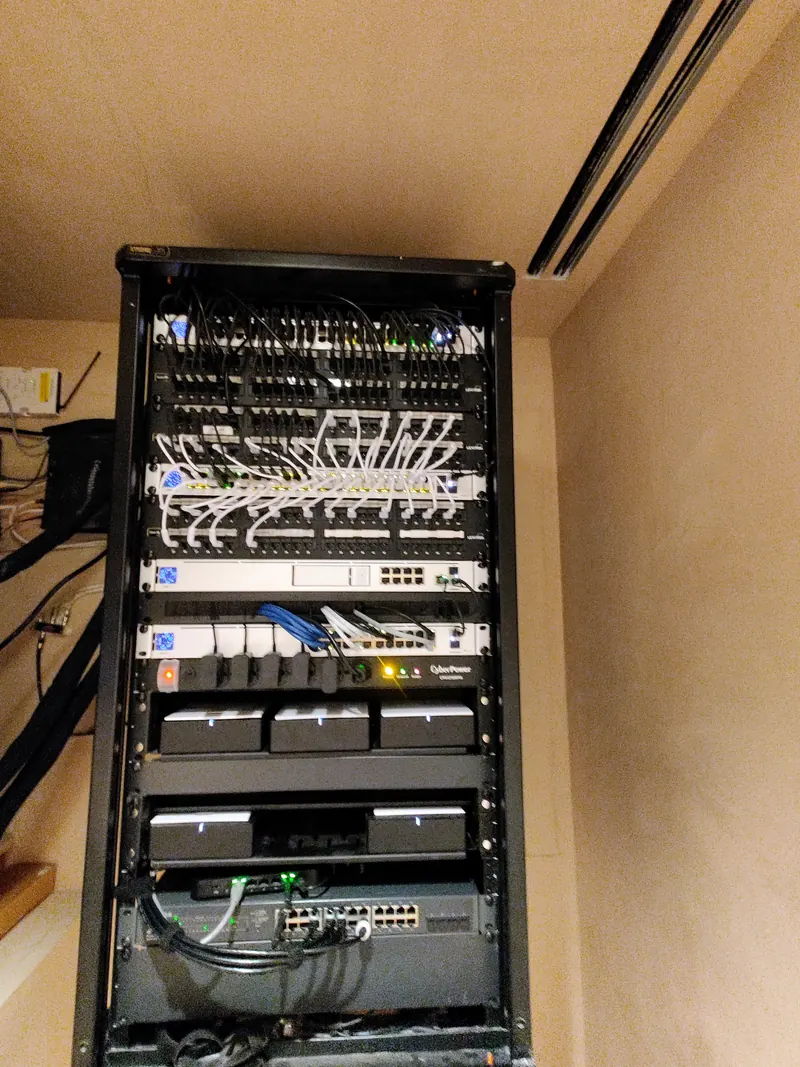
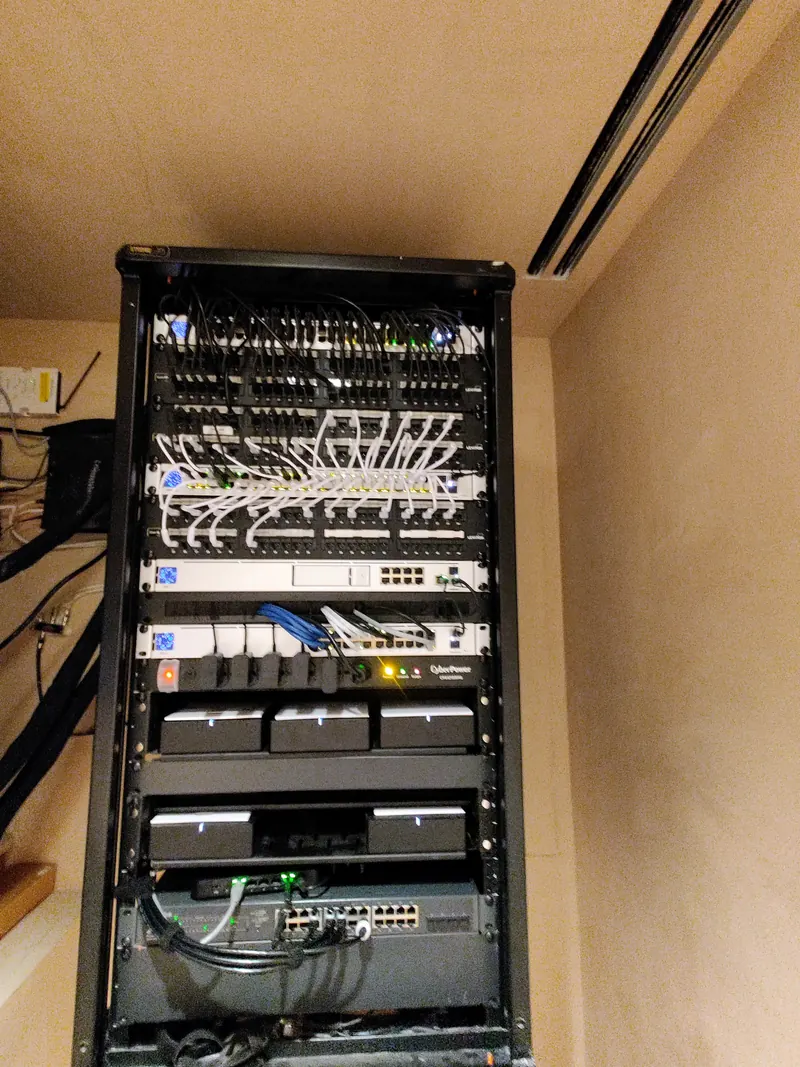
Core architecture. A Ubiquiti USW-Pro-Aggregation L3 platform at the main MDF, three units (two active in a 25G SFP28 DAC pair, one shelf spare), replaces the original Phase 1 core. Each Aggregation unit provides 28× 10G SFP+ ports and 8× SFP28 inter-switch/uplink ports under unified UniFi management. The 50 Gbps inter-switch DAC backbone gives the core 100 Gbps of aggregate switching headroom for future access-control, intercom, and Wi-Fi expansion without infrastructure modification.
Edge switching per building. Every new Phase 2-3 townhome building gets an outdoor NEMA 4 enclosure housing one or two EtherWAN EX78934X-0VB hardened PoE edge switches. The hardened EtherWAN platform tolerates exterior temperature and humidity that office-grade switching does not, eliminating the need for additional climate-controlled IDF space at each building.
Phase 1 preservation. The existing Phase 1 plant remains on its original multimode fiber. Eight SR ports on the new aggregation core uplink to the Phase 1 switches at 10G, so the existing 75-camera installation gains the new core’s management plane and routing fabric without any reconfiguration of the cameras themselves. Phase 1 multimode is preserved indefinitely; new builds run OS2 single-mode for 25G/40G/100G future-proofing.
Distributed NVR architecture. The combined ~305-camera load exceeds the per-server stream limit of a single Exacq NVR, so the design splits the load across two NVR servers connected via 10GBASE-SR fiber. Operators still see one console; the distribution is transparent at the management layer.
Fiber-plant specification. OS2 single-mode (ITU-T G.652.D, low-water-peak) on all new outside-plant and building-entrance runs. Six strands per cable minimum, two cables per conduit (active plus a fully unterminated physical spare), twelve strands total per building, sufficient to absorb future Phase 3-and-beyond expansion onto Lot RM-7 without trenching new conduit. Fiber acceptance testing is part of Sage’s scope; the fiber-contractor’s strand count and termination quality are verified before any switch programming begins.
Why this matters at campus scale
Multi-building campus surveillance is its own discipline. What works for a 16-camera office breaks at 160 cameras across 28 buildings. The architectural decisions (inter-building fiber pathways, distributed versus centralized NVR storage, edge versus aggregation switching, scalable IP planning, physical security for the network plant in every building) are not the questions you answer for a single site, and many are irreversible once installed.
Public-housing and multi-dwelling property operators face an additional constraint: the network does not just carry cameras. It carries property management workflows, future tenant-facing services, building-management systems, and increasingly the integrated access control and intrusion alarm that a property of this scale demands. Designing for the full long-term stack (not just the cameras being installed today) separates a 10-year asset from a 3-year replacement.
What Sage owns versus what the prime contractor owns
This project demonstrates the value of clean scope boundaries on multi-discipline campus work. Sage owns network design and engineering, switch programming and configuration, fiber acceptance testing, NVR network integration, VLAN/IP architecture, Phase 1 integration and cutover, network commissioning and stress test, and PE-stamped as-built drawings. The prime contractor owns project management, camera-platform supply and installation, Cat6 horizontal cabling at the building level, and VMS/NVR procurement. The general contractor owns underground conduit, NEMA enclosure mounting, and the civil work. Clear lines mean fewer “not my job” handoff failures during commissioning.
What we apply on every multi-building engagement
- Preserve what’s working. Phase 1’s multimode plant is integrated, not replaced. Forklift upgrades destroy budget and create unnecessary risk.
- Edge switching tolerates the environment it lives in. Hardened EtherWAN platforms outdoors mean no climate-controlled IDF closets at every building.
- Design the fiber plant for the next 15 years of buildings. Twelve strands per building today absorbs Phase 4 and 5 without trenching.
- Distributed NVR architecture for distributed risk. Splitting 305 streams across two NVRs keeps single-server failures from blacking out half the campus.
- Document everything. PE-stamped as-built drawings, network topology, rack elevations, fiber test reports, switch configuration backups: all delivered as part of the engagement, all owned by the property after handover.
Read how we built it
The full write-up (architecture, sequencing, and what we would do differently) unlocks here and lands in your inbox. One work email, no sales call unless you ask.
Unlocked: a copy is on its way to your inbox.
This result stays open on this device. Want the real number for your environment? Ask for a written quote.
Gallery
Stack we used
- Ubiquiti USW-Pro-Aggregation L3 core (2 active + 1 shelf spare, 25G SFP28 DAC inter-switch backbone)
- EtherWAN EX78934X-0VB hardened PoE edge switches in NEMA 4 outdoor enclosures (one or two per townhome building)
- OS2 single-mode fiber for new Phase 2-3 backbone (6 strands per cable, 2 cables per conduit, 12 strands per building, 200%+ growth margin)
- Existing OM3 multimode integrated via 10G SR uplinks (no rip-and-replace)
- Exacq NVR servers, dual deployment via 10GBASE-SR fiber for combined stream-count headroom
- VLAN segmentation isolating surveillance from property management, future access control, and future Wi-Fi
- BICSI TIA-568, TIA-569, TIA-606, TIA-607-compliant pathway, labeling, and grounding
More case studies
- Construction
Construction Firm Office Relocation: Cabling, Network, and Phones in One Weekend
A 35-person construction firm in Staten Island moved offices on a Friday evening and walked into a fully working environment Monday morning: cabling, switches, phones, AV, the whole stack.
Read more about Construction Firm Office Relocation: Cabling, Network, and Phones in One Weekend - Healthcare
Healthcare Practice Scales 12 → 47 Endpoints with HIPAA-Aware IT
A growing NJ healthcare practice migrated to Microsoft 365, segmented its network, and grew from 12 to 47 endpoints without IT growing pains or compliance gaps.
Read more about Healthcare Practice Scales 12 → 47 Endpoints with HIPAA-Aware IT - Transportation & Logistics
Logistics Company Builds Out 28,000 sq ft Warehouse with Cameras, Access, and Wi-Fi
A growing 3PL company opened a new warehouse in northern New Jersey and engaged Sage to handle every piece of low-voltage and IT infrastructure: structured cabling, Wi-Fi, security cameras, access control, and the back-office network.
Read more about Logistics Company Builds Out 28,000 sq ft Warehouse with Cameras, Access, and Wi-Fi
Want results like these?
A 30-minute call gets you a written assessment in 48 hours.